Selecting the Right Carbide Rod Forming Process: Die Pressing vs. Extrusion vs. Dry Bag Isostatic Pressing
Writer: admin Time:2026-08-31 17:21:40
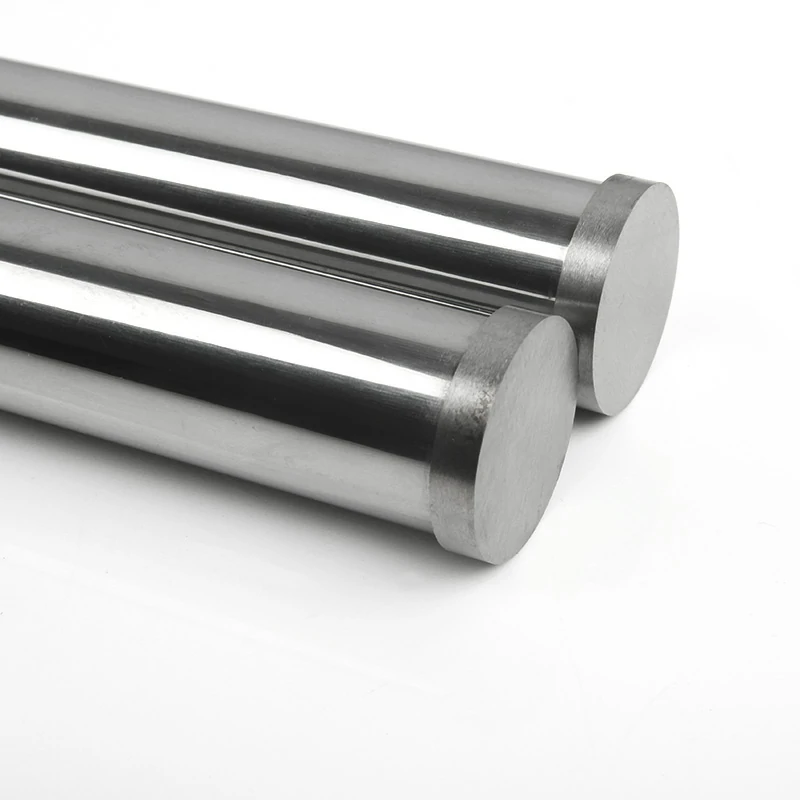
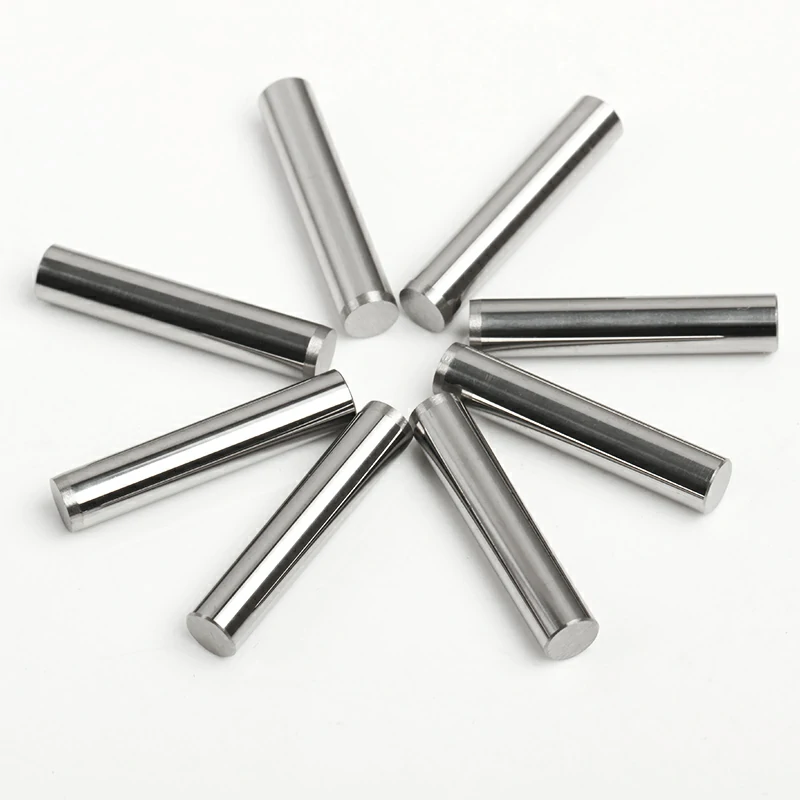
In the metal cutting industry, cemented carbide rods (tungsten carbide rods) serve as the core substrate for manufacturing drills, end mills, reamers, and custom rotary cutting tools due to their exceptional hardness, wear and corrosion resistance, and high toughness.
The forming quality of a carbide rod directly determines the precision, structural integrity, and service life of the finished cutting tool. Currently, the industry relies on three mainstream forming processes: Die Pressing, Precision Extrusion Molding, and Dry Bag Isostatic Pressing. Each method offers distinct technical advantages tailored to specific tool designs and production scales.
HAO CARBIDE breaks down these three forming technologies to help you select the ideal carbide rod solution for your manufacturing needs.
1. Die Pressing: The High-Precision Choice for Standard Short Rods
Working Principle
Die pressing involves filling a carbide powder mixture (blended with a forming agent) into a precision metal mold. Unidirectional or bidirectional pressure is applied via a press to compact the powder directly into a green rod body.
Key Product Features
High Dimensional Accuracy: Mold constraints ensure high consistency in green body outer diameter (OD) with minimal deformation during sintering.
Mature & Cost-Effective: Easy operation and low processing costs make it ideal for high-volume, standardized manufacturing.
High Production Efficiency: Delivers the fastest pressing speed for large batches of small-sized carbide rods.
Technical Limitations
Die pressing requires high-grade molds, and rod length is strictly limited by mold dimensions. During horizontal pressing, the gap between the top and bottom punches forms a "rib edge" (burr) along the green body. This requires secondary trimming, adding processing steps and introducing yield rate fluctuations.
Best Suited For
Short-length, small-diameter, high-volume standard carbide rods.
2. Precision Extrusion Molding: The Long & Coolant-Hole Rod Specialist
Working Principle
In precision extrusion molding, the carbide powder mixture is blended with an organic binder. Under extruder pressure, the plasticized mixture is continuously forced through mold dies and cores to form the target shape and dimensions.
Key Product Features
Continuous Long-Length Production: Theoretically allows infinite rod length, fulfilling requirements for high aspect ratio tools.
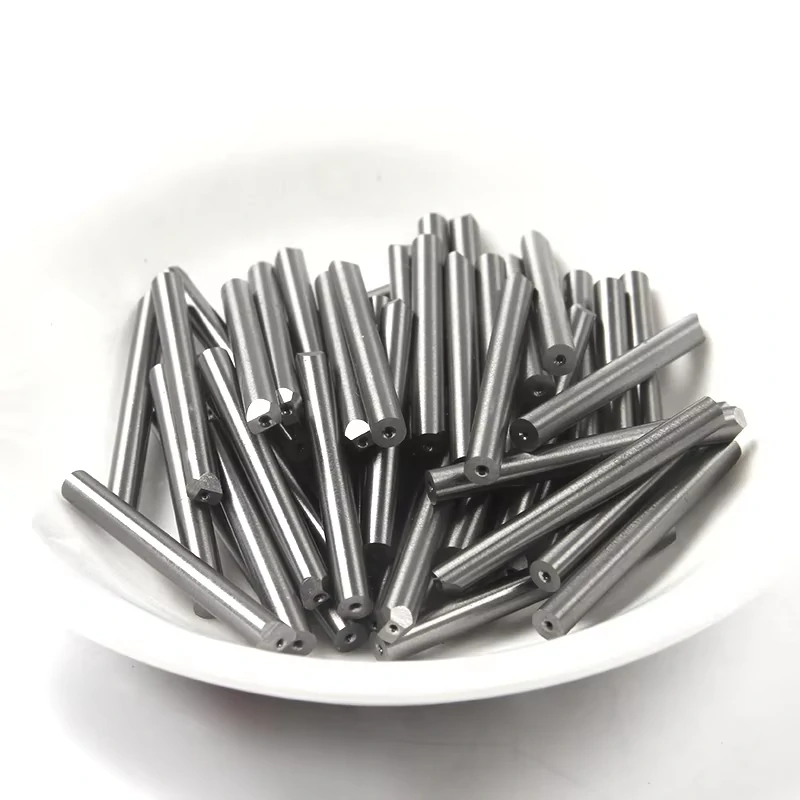
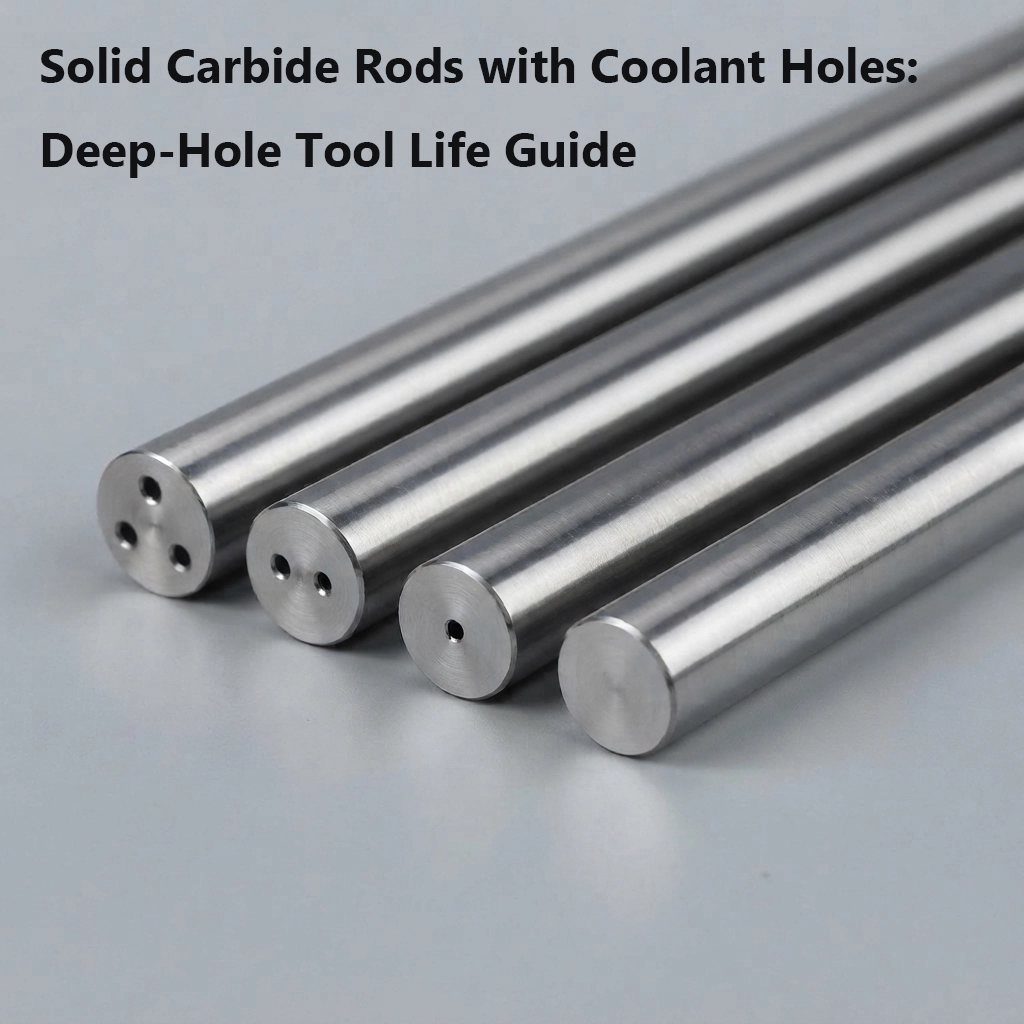
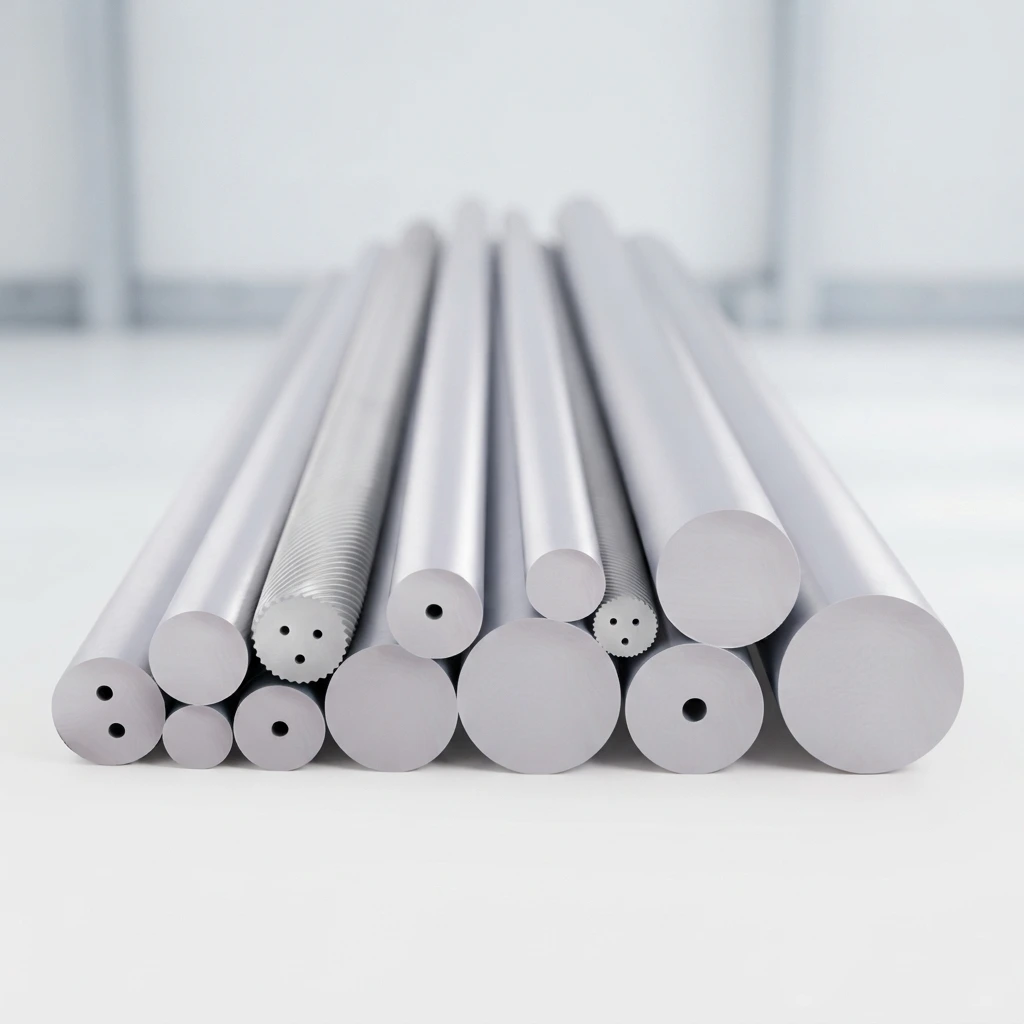
The Premier Choice for Internal Coolant Holes: Extrusion is the ultimate process for producing carbide rods with straight or helical coolant holes. Placing core rods in the die core yields internal cooling channels with high straightness, roundness, and positioning accuracy.
Uniform Density: Continuous material flow during extrusion ensures higher green body density consistency compared to traditional die pressing.
Technical Limitations
Extrusion requires a higher proportion of forming agents. Consequently, the dewaxing and sintering processes must be strictly controlled to prevent shrinkage, warpage, or cracking.
Best Suited For
Ultra-long carbide rods, straight internal coolant hole rods, and helical coolant hole rods.
3. Dry Bag Isostatic Pressing: The Uniformity & Large-Diameter Master
Working Principle
Carbide powder is loaded into a semi-fixed flexible mold (the "dry bag") anchored inside a high-pressure vessel. Fluid medium (water or oil) exerts equal, uniform hydrostatic pressure from all directions to compact the powder into a dense green body.
Key Product Features
Ultimate Structural Uniformity: Omnidirectional fluid pressure delivers extremely uniform green density. Sintered rods exhibit uniform grain structures, zero internal stress, and highly stable mechanical performance.
High Flexibility & Scalability: Features relatively low mold costs and rapid tooling changeover. It easily presses ultra-large diameters and ultra-long carbide blanks.
High Green Body Strength: Compaction yields strong green bodies that are easy to handle and machine (such as lathe turning) prior to sintering.
Technical Limitations
Production efficiency is lower than automated die pressing. Additionally, the outer diameter accuracy of the green body is lower than that of die-pressed rods, requiring subsequent vertical lathe machining.
Best Suited For
High-end solid carbide rods, large-diameter rods, custom shaped components, and precision tool blanks requiring maximum structural uniformity.
Technical Selection Guide: How to Choose the Right Forming Process
Selecting the optimal forming method depends on tool geometry, coolant requirements, and dimensions.
Dimension 1: Internal Coolant Holes
Does your tool require internal cooling channels?
If manufacturing internal coolant tools (such as high-pressure coolant end mills or internal coolant drills), Precision Extrusion Molding is the ONLY viable choice. Extrusion directly forms straight or helical coolant holes with guaranteed straightness, roundness, and location accuracy. Die pressing and dry bag pressing cannot directly form precision internal cooling holes.
Dimension 2: Geometric Dimensions (Length & Diameter)
Ultra-Long (Length > 150 mm) or Ultra-Fine (Diameter < 3 mm):
Select Extrusion Molding. Extrusion supports continuous output without length limits and reliably produces micro-diameter rods for micro drills, micro end mills, and deep-hole drills.
Large Diameter (Diameter > 30 mm):
Select Dry Bag Isostatic Pressing. Die pressing large diameters requires massive, expensive tooling with uneven pressure distribution. Extrusion suffers from poor material flow in large cross-sections. Dry bag pressing easily handles large diameters while maintaining uniform density.
Standard Dimensions (Diameter Ø6 mm–20 mm, Length ≤ 100 mm):
All three processes are technically feasible. Select based on batch size, tolerance, and cost parameters.
Summary of Forming Process Characteristics
| Feature / Metric | Die Pressing | Precision Extrusion Molding | Dry Bag Isostatic Pressing |
|---|
| Primary Advantage | High OD accuracy, fast for short rods | Continuous long length, coolant holes | Extreme density uniformity, large OD |
| Coolant Hole Capability | Not Applicable | Yes (Straight & Helical) | Not Applicable |
| Max Length Capability | Short (Limited by mold) | Ultra-Long (>150 mm) | Long to Ultra-Long |
| Large Diameter Capability | Limited | Limited flowability | Excellent (>30 mm) |
| Density Uniformity | Moderate | High | Superior (Isostatic) |
| Secondary Processing | Rib edge / burr trimming required | Dewaxing / strict sintering control | Vertical lathe OD turning required |
HAO CARBIDE: Advanced Manufacturing & Quality Assurance
HAO CARBIDE has fully mastered all three forming technologies (Die Pressing, Precision Extrusion Molding, and Dry Bag Isostatic Pressing) with state-of-the-art production lines and equipment.
Our premium solid carbide rod products are widely utilized to manufacture solid carbide cutting tools designed for machining:
Carbon steels, alloy steels, and stainless steels
Non-ferrous metals and titanium alloys
Difficult-to-machine superalloys
Carbon fiber composites (CFRP), graphite, and PCB boards
Wood and engineering plastics
Full-Process Quality Control (ERP + MES)
HAO CARBIDE operates an integrated ERP + MES (Manufacturing Execution System) network that manages every detail of production. From initial R&D design and raw material processing to quality supervision and sales service, production data is collected, monitored, analyzed, and adjusted in real time. This end-to-end digital tracking ensures rigorous batch-to-batch consistency and full product traceability, delivering reliable carbide rod blanks for precision toolmakers worldwide.